
Do you want to be informed on new Posts on this Thread? (members only)
| S&S Swan General - Cost to replace teak deck |
|---|
|
Join Date: 30 March 2008
Posts: 1 |
||
|---|---|---|
|
Cost to replace teak deck |
|
Join Date: 30 January 2007
Posts: 8 |
||
|---|---|---|
|
hI The cost in 2000 for a swan 41 including new hatches and 14 mm teak was about 25000 Euros Youen |
|
Join Date: 26 May 2007
Posts: 9 |
||
|---|---|---|
|
We had the teak deck on our Swan 41 replaced this winter. Including disassembling all fittings, removing the old teak, preparing the subdeck, laying a new 12mm epoxy-bonded teak deck and putting all hardware and fittings back the cost worked out at € 1150 per square metre.
|
|
Join Date: 27 February 2007
Posts: 36 |
||
|---|---|---|
|
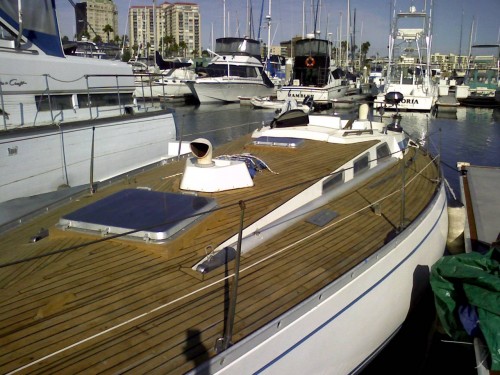
Not sure how bad your teak deck is. I thought that the teak on our boat was in bad shape, but I found some guys who were able to refinish the existing teak deck (replacing areas where needed with new teak, king plank, cockpit, around mast, etc.). This took the 2 guys we hired to do the work about 6 weeks, and cost us around 13,500 USD in labor and about 1,500 USD in supplies (mostly caulking). That is less than 10,000 Euros (USD is at such a low right now). And for that price, they unscrewed all screws, drilled and filled with epoxy, and then rescrewed, routed out slightly wider grooves, recaulked with Teak Decking Systems caulking) and sanded down the entire surface. I'm hoping this gets us another 10+ years with the existing decks. They were pretty thick to start, and after 30 years are still ok thickness. I would have loved a completely new teak deck. But at an estimated $50,000 (or more) Euros compared to $10,000 Euros. In my assessment, a new deck wasn't 5 times prettier than a refinished teak deck. Of course, if this job doesn't last, I might be doing a new teak deck 10 years down the road. After photo attached...
 |
|
Join Date: 30 January 2007
Posts: 467 |
||
|---|---|---|
|
What you write is very interesting because I have been thinking to do something similar myself. I have few questions in particular: 1) the screws are still there or they were completely replaced by glue? In case yes, do you have the name of the glue? 2) how was the interspacing between two contiguous planks dealt with? Namely, were the planks planed on the side in order to let the caulking occupy all the space from the surface down to the underlying fiberglass? 3) do you have any suggestion on how to deal with the rails and any equipment fixed on deck?
|
|
Join Date: 27 February 2007
Posts: 36 |
||
|---|---|---|
|
Screws are still there. (In our case new screws, slightly wider than original, old holes drilled wider filled with epoxy before drilling new screws in. New screws only go into the epoxy hole, they do not go through the epoxy - keeping this water tight is key). Not - even without the screws the 95% of the old planks were still bonded to the fiberglass. Where they were loose or popping up, they were either replaced, or epoxy was used to re-bond them to the fiberglass. No glue was used in our case. New plugs to cover the new screws should also be a little bigger than old plugs - epoxy also used to bond the plugs in place. The spaces/grooves between each plank were sanded/re-grooved using saws and routers and guided by hand. This removed all the old caulking, and provided a fresh clean surface for the new caulking. New caulking lines are now a little bit thicker than before. The caulking (Teak Decking Systems) provides additional sealing, bonding, flexing, between the teak. This particular caulking is the best for teak jobs, and the guys I used won't use anything else. Anything on the deck that can be removed should be removed. For us this meant removing 4 30 year old Lewmar winches that haven't been off the boat since the day they were mounted, teak cleats, etc... (our mast was out of the way, as was all rigging, making it a whole lot easier to move around on the deck). Rail - didn't touch the rail or the stanchions, just worked around them. Created a new very thin groove between the rail and the outermost teak planks, and used a different caulk to seal this spot. (need to use a caulk with better bonding between teak and metal, as the TDS stuff is better for teak only. If you do take this step, make sure your deck is dry for 2 reasons. 1) the teak shrinks when it is most dry, and expands when wet, you don't want it to shrink after caulking as it may separate from the bonding. If it expands after caulking when wet then it just compresses the caulking seal, which is what you want. 2) you don't want any moisture below your newly sealed deck if any is present. Hope this helps. If I had the cash, I would get all new teak and glue it down. Check out Matteo's deck, that is some beautiful work. -Nathan (s/v Inspiration 38/090 |
|
Join Date: 10 February 2008
Posts: 18 |
||
|---|---|---|
|
We replaced a couple of years ago the teak deck on our Swan 38 Jacaranda 38/59. The total cost was approx 25.000 EURO plus approx 3000 EURO for the teak wood. We removed the old teak deck and all hardware our self (2 weeks hard work for me and my wife !!!!) and Walsteds Boatyard in Denmark took over, finalizing the new teak deck incl. fitting of all old and new hardware. Instead of using screws, Walsted Boatyard used epoxy and the outcome is just great. You can see pictures of our teak deck under classic swan maintenance. Jorgen "Jacaranda" 38/059 |
- Threads : 1804
- Posts : 10761
- Members: 862
- Online Members: 0
